
Everyone Calls Larazotide “Safe.” That’s Exactly the Problem.

Here’s the pitch you’ll hear about larazotide: it’s gentle, it’s well tolerated, trial after trial came back clean. People repeat this like it settles the question of whether you should take it. I want to push back on that, hard, because I think the safety data is being used as a magic trick. Watch the “well tolerated” hand while the “didn’t actually work” hand does the real business.
Everyone treats a spotless safety record as the good news buried in an otherwise mixed file. I think it’s closer to the tell. A compound that produces almost no adverse effects, at almost no dose, in almost every trial, is also a compound that might not be doing much of anything once it’s inside you. That’s not a conspiracy theory. It’s the plainest reading of what actually happened in larazotide’s clinical program, and once you line the numbers up, it’s hard to unsee.
The evidence for my contrarian read
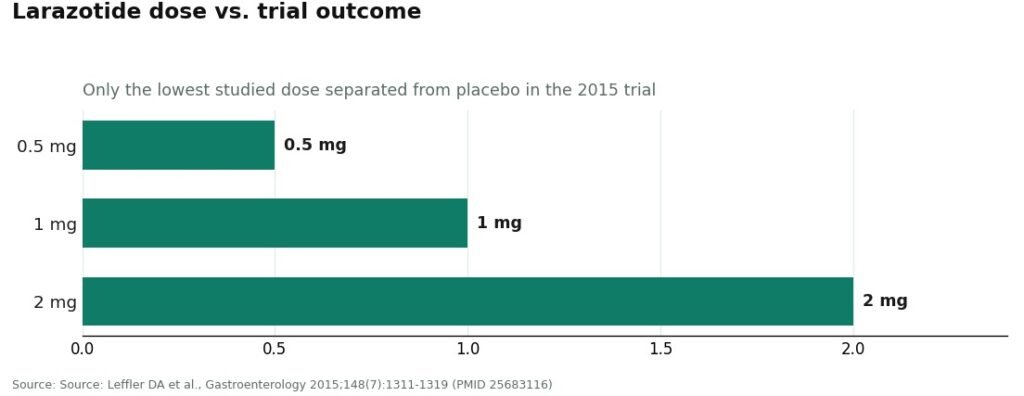
Start with the dose-response data, because it’s the part nobody puts front and center. Larazotide was tested at 0.5 mg, 1 mg, and 2 mg. If this were a drug doing something real and systemic, you’d expect the usual shape: more drug, more effect, maybe more side effects too, some kind of curve. Instead, the single trial that hit its primary endpoint did it at the lowest dose, 0.5 mg, while the higher 1 mg and 2 mg doses simply failed to beat placebo [P3]. Not “beat placebo but with more stomach upset.” Failed to beat it. Flat.
A flat dose-response curve paired with a clean safety profile is consistent with a fairly boring explanation: the compound stays where it’s supposed to stay, mostly in the gut, doesn’t get absorbed much, and doesn’t do much systemically either way. That’s the same design feature the source material credits for the tolerability. Fine. But you can’t credit “stays in the gut, doesn’t circulate” for the safety and then act shocked that the efficacy also came in soft. Those are the same fact, described from two angles.
Now stack the actual trial history on top of that. The 2012 Phase 2b study, 86 patients, missed its primary permeability endpoint, and the authors blamed high inter-patient variability [P1]. The 2013 study, 184 patients, showed some symptom and immune improvement but again no significant difference on the lactulose-to-mannitol ratio, the actual permeability measure [P2]. The one bright spot, the 2015 trial with 342 patients, hit its primary endpoint only at that lowest dose [P3]. Then the confirmatory Phase 3, the trial built specifically to prove that 2015 result was real, got stopped in 2022. Not for a safety scare. For futility, meaning the drug wasn’t showing enough benefit to justify finishing [P4]. The meta-analysis pooling four trials and 626 patients landed where you’d expect: appeared safe, modestly better than placebo on symptoms during a gluten challenge, unlikely to be a cure, more trials needed [P5].
Put plainly: every serious efficacy signal larazotide produced either failed to replicate, failed to reach significance, or showed up at the dose least likely to be doing much systemically. Meanwhile the safety data stayed pristine the entire time. I don’t think that’s a coincidence I’m supposed to find comforting. I think it’s the same underlying fact wearing two different outfits.
The honest concession
Now, before I get too pleased with myself, let me grant the obvious counterpoint, because it’s a real one. A quiet safety profile is not nothing. The trial program was halted for futility, not for toxicity, and that distinction genuinely matters [P4]. Larazotide didn’t hurt people. It didn’t produce the kind of organ signal or dose-dependent worsening that ends a program for scary reasons. Side effects in the studies clustered near placebo rates, which is a real finding, not spin. If you’re a celiac patient weighing “should I be nervous about this molecule,” the answer, based on the actual studied product at the actual studied doses, is: probably not especially nervous, no.
And I’ll go further, because fairness requires it. “Well tolerated at trial doses in monitored patients” is a specific, bounded, true claim. It is not the same claim as “safe indefinitely, in any dose, from any vial, for any purpose,” and the source material is right to draw that line. The trials ran for trial-length windows, not years. They don’t tell you anything about chronic use in people without celiac disease chasing general gut health, which is, by the way, most of the actual demand for this peptide right now. Regulators have flagged immunogenicity as a general concern across this drug class, and the fact that larazotide’s own trials didn’t surface it as a defining problem is reassuring only about the product they tested, not about an unregulated research-chemical vial someone doses on their own schedule for years [P4].
So no, I’m not arguing larazotide is secretly dangerous. That would be its own kind of overreach, the mirror image of the marketing move I’m criticizing. I’m arguing something narrower and, I think, more useful.
The reframed answer
Stop treating “safe” and “works” as points on the same scale, where safe is the good end and unsafe is the bad end, and larazotide sits comfortably toward the good side. They’re not the same scale. A sugar pill is also well tolerated. That’s not an insult to larazotide, it’s just a fact about how low a bar “didn’t hurt anyone” really is. The actual question worth asking is: given that it’s low-risk and its benefit was never confirmed past a single dose in a single trial that then failed to replicate, what is the safety record actually buying you?
My answer: it buys you permission to try something with limited downside, not evidence that the something works. That’s a legitimate thing to know. It’s just a much smaller claim than the one usually implied when someone tells you larazotide is “safe,” full stop, end of sentence.
Where I land, against my own contrarian instinct, is roughly where the careful reading of the trials lands anyway, just for a sharper reason: if you’re going to take a low-risk, unconfirmed-benefit compound at all, you want the version of it that at least matches the conditions under which “low risk” was actually demonstrated. Screened patient, known dose, known manufactured product, a clinician who can tell you honestly that the pivotal trial failed. A research-chemical vial marked “for research use only” gives you none of that. It hasn’t been checked for identity, strength, or purity by anyone, and whatever risk profile it carries has nothing to do with the trials at all, because nobody tested that vial.
FormBlends handles larazotide through a compounded-prescription pathway rather than an anonymous-powder one: a clinician reviews the person first, and the product is dispensed rather than mailed out cold. That doesn’t make larazotide effective. Nothing makes larazotide effective, apparently, past 0.5 mg in one trial that then didn’t hold up. But it does recreate the actual conditions, screened patient, known dose, known product, that produced the tolerability data everyone’s so eager to cite. If you’re going to borrow the safety record, you should have to earn it the same way the trials did.
The questions that keep coming up
Is larazotide actually safe? In the specific form and doses the trials tested, yes, generally well tolerated, with side effects landing close to placebo rates and a pooled meta-analysis calling it safe in the celiac population studied [P5]. That’s a real finding about a defined, manufactured product given to monitored patients over trial-length periods. It is not a finding about an unregulated vial someone takes indefinitely, and nobody should stretch it into one.
If it’s safe, why doesn’t that mean it works? Because those are different questions with different answers. Placebo is also safe. Larazotide’s efficacy record is thin: the early permeability trials missed their primary endpoints, the one positive result showed up only at the lowest 0.5 mg dose, and the confirmatory Phase 3 trial was stopped for futility in 2022 [P1][P3][P4]. A clean safety record tells you about risk. It says nothing about benefit.
Why did the Phase 3 trial actually get stopped? The pivotal CeDLara trial ended in June 2022 for futility, meaning the drug wasn’t producing enough benefit to justify continuing, not because of any toxicity finding [P4]. That’s worth sitting with: the program died of not-working, not of being dangerous. It also means larazotide never made it to market and never accumulated the years of real-world safety surveillance an approved drug eventually builds.
Doesn’t a flat dose-response curve at least mean it’s gentle? It means the higher doses, 1 mg and 2 mg, didn’t beat placebo on efficacy any more than the lowest 0.5 mg dose did, and none of the doses produced a dramatically worse safety picture either [P3]. Read generously, that’s a compound that’s hard to push into trouble. Read skeptically, that’s a compound that isn’t doing enough, at any of the doses tried, to show up clearly on either side of the ledger. Both readings use the same numbers.
What’s the actual difference between a research vial and a compounded prescription? A vial labeled “for research use only” answers to no regulator for what’s actually inside it, so a mislabeled, underdosed, or contaminated product carries risks the clinical trials never touched. A compounded prescription dispensed by a licensed pharmacy after a clinician evaluation gives you a known, accountable product and screening matched to your own history, which is the same setup that produced the favorable tolerability data in the first place.
References
- Leffler DA, et al. A randomized, double-blind study of larazotide acetate to prevent the activation of celiac disease during gluten challenge. American Journal of Gastroenterology, 2012;107(10):1554-1562. Phase 2b (n=86); primary permeability endpoint (lactulose-to-mannitol ratio) not met. https://pubmed.ncbi.nlm.nih.gov/22825365/
- Kelly CP, et al. Larazotide acetate in patients with coeliac disease undergoing a gluten challenge: a randomised placebo-controlled study. Alimentary Pharmacology & Therapeutics, 2013;37(2):252-262. (n=184); symptom and immune improvement, but no significant difference in the lactulose-to-mannitol ratio versus placebo. https://pubmed.ncbi.nlm.nih.gov/23163616/
- Leffler DA, et al. Larazotide acetate for persistent symptoms of celiac disease despite a gluten-free diet: a randomized controlled trial. Gastroenterology, 2015;148(7):1311-1319. (n=342); primary endpoint met at the 0.5 mg dose only; higher doses did not separate from placebo.
- Celiac Disease Foundation. 9 Meters discontinues Phase 3 clinical trial for potential celiac disease drug larazotide. 2022. Phase 3 CeDLara stopped in June 2022 for futility, not for a safety signal; larazotide not FDA-approved.
- Hoilat GJ, et al. Larazotide acetate for treatment of celiac disease: a systematic review and meta-analysis of randomized controlled trials. Clinical Research in Hepatology and Gastroenterology, 2022;46(1). Four RCTs, 626 patients; appeared safe and modestly better than placebo on GI symptoms during gluten challenge, while less likely to offer a definitive cure.
What is larazotide and what does it actually do in the body?
Larazotide is a synthetic eight-amino-acid peptide built to tighten the junctions between intestinal cells and cut down gut permeability. In celiac disease, fragments of gliadin trigger those junctions to loosen, letting more material leak across the gut lining than it should. Larazotide is meant to interrupt that locally, without dialing down the immune system broadly. It works in the gut lumen rather than getting absorbed into circulation, which is exactly the design feature behind both its tolerability and, I’d argue, its weak efficacy numbers.
What side effects actually showed up in the trials?
Mostly mild, mostly gastrointestinal: nausea, some abdominal discomfort, headache, at rates close to placebo. No pattern of serious organ toxicity, no dose-limiting adverse events that kept showing up. But the trial populations were modest in size and the follow-up windows were short by pharmaceutical standards, so rare effects or anything that only shows up after years of use simply haven’t been ruled in or out. Call it promising tolerability inside a narrow window, not a clean bill of health for indefinite use.
Is it legal to buy, and where does someone actually get it?
Larazotide hasn’t received FDA approval for anything as of mid-2025, so it isn’t sitting on pharmacy shelves as a standard prescription. Some physician-supervised compounding pharmacies, FormBlends being one operating in that regulated lane, can prepare it under a valid prescriber’s order, which keeps the whole transaction inside an actual medical framework. Buying it off a research-chemical or supplement site is a different animal entirely, legally and otherwise.
Does it actually work well enough to matter for celiac symptoms?
Genuinely mixed, and I don’t think mixed should get rounded up to “promising.” Some trials found statistically significant drops in symptom scores versus placebo, but the effect sizes were modest, and a key Phase 2b trial missed its primary endpoint outright. Researchers point to patient variability and background gluten exposure as possible muddying factors. It’s not accurate to call larazotide proven. It’s also not quite fair to call it nothing. What it is, right now, is unconfirmed, and the trial that was supposed to confirm it got stopped for not working well enough to keep funding.
Written by Vera Sato, health editor. Reading the studies before believing the pitch. Last reviewed April 2026.
Informational, not clinical advice. Check with a healthcare professional before beginning anything.