
Master the Art of Inquiry: How Students Can Improve Research Skills for Academic Writing in 2026
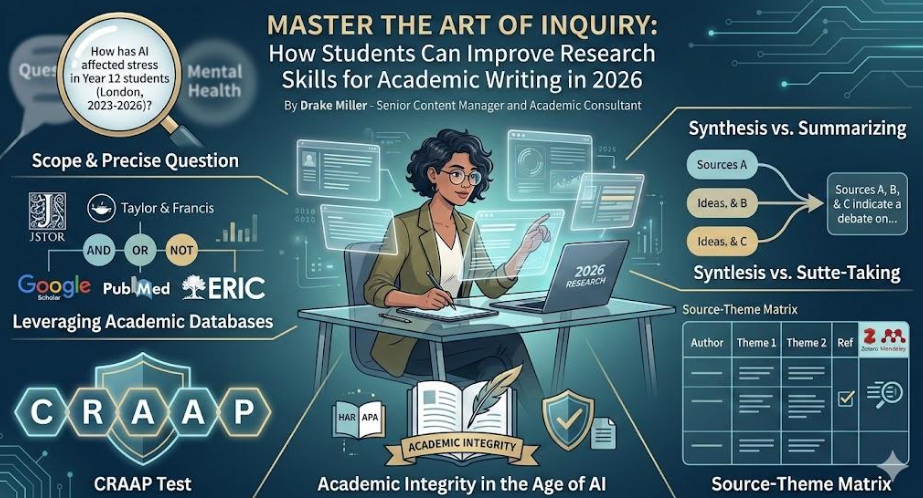
By Drake Miller – Senior Content Manager and Academic Consultant
In the modern academic landscape of 2026, the ability to conduct high-level research is no longer just an advantage—it is a fundamental requirement for success. Whether you are navigating the final years of high school in the UK, tackling the Extended Project Qualification (EPQ), or embarking on a rigorous university degree, the transition from “searching for information” to “conducting scholarly research” is a pivotal step.
For students today, the challenge is rarely a lack of information; rather, it is the overwhelming abundance of it, complicated by the rise of generative AI and shifting digital algorithms. Improving your research skills ensures that your academic writing is grounded in evidence, exhibits critical thinking, and maintains the highest standards of academic integrity.
1. Defining the Scope: The Power of a Precise Research Question
Effective research begins long before you open a search engine. The most common pitfall for students is starting with a topic that is too broad, such as “Climate Change” or “The Industrial Revolution.” This leads to a superficial collection of facts rather than a cohesive argument. In the 2026 UK curriculum, markers are looking for “specific inquiry,” which demonstrates a student’s ability to identify niche gaps in knowledge.
To improve your research outcomes, focus on developing a “Searchable Question.” Consider the difference:
- Broad Topic: Mental Health in Schools.
- Focused Question: How has the integration of AI-powered mindfulness apps affected the stress levels of Year 12 students in London-based academies over the last three years?
By narrowing your focus, you create a roadmap. This specificity allows you to identify exactly what data you need, saving hours of aimless scrolling. For those in specialized creative fields, looking at niche fashion dissertation topics can provide excellent inspiration for how to narrow down a broad interest into a researchable, high-level academic inquiry.
2. Leveraging Academic Databases and Digital Libraries
While general search engines are useful for preliminary background reading, academic writing requires “peer-reviewed” and “authoritative” sources. As a student, your primary tool should be your institution’s digital library and specialized databases. Understanding how to navigate these is the difference between a 2:1 and a First Class grade.
- Google Scholar: A powerful middle ground. Use the “Cited by” feature to find influential papers in your field.
- JSTOR and Taylor & Francis: Excellent for humanities and social sciences.
- PubMed: The gold standard for science and healthcare students.
- ERIC: Indispensable for education-focused research.
When using these platforms, master the use of Boolean Operators. Using “AND,” “OR,” and “NOT” helps filter results efficiently. For example, searching for “Artificial Intelligence AND Education NOT Robotics” ensures your results focus on learning systems rather than hardware. Furthermore, using quotation marks for exact phrases—such as “academic performance in hybrid learning”—will significantly reduce irrelevant search results.
3. Upholding Academic Integrity in the Age of AI
Academic writing is built on trust. Every time you use an idea, statistic, or theory that is not your own, you must credit the original creator. In the UK, the Harvard Referencing System and APA are the most common styles, but always check your specific department’s handbook.
With the rise of AI tools in 2026, academic integrity also involves being transparent about your methodology. Proper referencing does more than prevent plagiarism; it strengthens your argument by showing that respected experts support your claims. For students navigating the transition to university or tackling complex dissertation writing services , seeking academic consultancy can provide the necessary framework to master these research standards. Expert guidance can provide clarity on how to structure these references correctly and ensure your bibliography is flawless.
4. Evaluating Source Credibility (The CRAAP Test)
In an era of digital misinformation and AI-generated hallucinations, the ability to vet a source is a critical academic skill. One of the most effective frameworks used by UK educators is the CRAAP Test. Applying this ensures your Information Gain is high-quality and reliable.
- Currency: Is the information up to date? For STEM and EdTech subjects, sources older than three to five years may be obsolete.
- Relevance: Does the information actually answer your specific research question? Does it address the UK context if your essay is location-specific?
- Authority: Who is the author? Are they an expert in this field? Is the publisher a university press or a respected journal?
- Accuracy: Is the information supported by evidence? Are there citations for their claims? Check for internal consistency in the data provided.
- Purpose: Is the source objective, or is it trying to sell a product or push a specific political or social agenda?
Using a variety of sources—including monographs, peer-reviewed journal articles, and official government white papers—adds layers of E-E-A-T to your work.
See also: Houston Trucking Collisions: Who Can Be Held Responsible?
5. Synthesizing Information vs. Summarizing
A common mistake in student writing is “patchwork writing,” where various quotes are simply strung together with little transition. To elevate your work, you must move toward synthesis. Synthesis is the process of taking multiple sources and identifying patterns, conflicts, or gaps between them.
Instead of saying “Author A says X and Author B says Y,” a high-level researcher says:
“While Author A argues for X, Author B suggests that Y is more likely, particularly in the context of UK urban schools, indicating a growing debate regarding the long-term efficacy of digital interventions.”
This demonstrates a high level of expertise. It shows you aren’t just a passive consumer of information, but an active participant in the academic conversation. It proves you have understood the relationships between different studies, which is a hallmark of sophisticated academic research.
6. Strategic Note-Taking and Organization
The most frustrating part of research is finding a perfect quote and then forgetting which website or book it came from. Developing a systematic approach to note-taking is essential for efficiency.
- Digital Tools: Use tools like Zotero or Mendeley to save citations as you find them. These tools can automatically generate bibliographies, saving you hours during the final submission phase.
- The Source-Theme Matrix: Create a table where the columns are your main essay themes (e.g., “Cost,” “Accessibility,” “Effectiveness”) and the rows are your sources. This allows you to see at a glance which authors support which part of your argument and where you might need more evidence.
Frequently Asked Questions
Q.1 How do I know if my research topic is “academic” enough for university?
A topic is academic when it moves beyond general knowledge and addresses a specific “how” or “why.” If your topic can be answered with a simple “yes” or “no,” it needs more depth. Use the “So what?” test: ask yourself why your finding matters to your field of study.
Q.2 Can I use AI tools like ChatGPT to find sources?
While AI can help brainstorm keywords, it is notorious for “hallucinating” or inventing citations. In 2026, UK universities will have strict policies regarding AI. Always verify every source provided by an AI through an official database like JSTOR before including it in your bibliography.
Q.3 What is the best way to manage research for the Extended Project Qualification (EPQ)?
For the EPQ, your “Production Log” is as important as the essay itself. Record your search terms, the databases you used, and why you rejected certain sources. This demonstrates the “Reflective Learning” that UK markers prioritize.
Q.4 How do I avoid “Imposter Syndrome” when reading complex academic journals?
It is normal to find high-level journals challenging. Start by reading the Abstract and the Conclusion first. This gives you the “big picture” before you dive into the complex methodologies. As you build your vocabulary, the middle sections will become easier to navigate.
Conclusion: Becoming a Lifelong Researcher
Improving your research skills is a journey. It begins with curiosity, is fueled by structured searching, and is refined through critical evaluation. By moving beyond surface-level searches and embracing academic databases, rigorous source vetting, and synthesis, you prepare yourself for the highest levels of academic achievement.
Effective research doesn’t just make your current essay better; it equips you with the analytical tools necessary for a successful career in a knowledge-driven world. Start small, be systematic, and never stop questioning the information in front of you.
About the Author:
Drake Miller is a senior content manager and academic consultant with over a decade of experience in higher education strategy. He specializes in helping students navigate the complexities of academic writing and digital research in an ever-evolving educational landscape. His work focuses on integrating E-E-A-T principles into student output to ensure long-term academic success.